
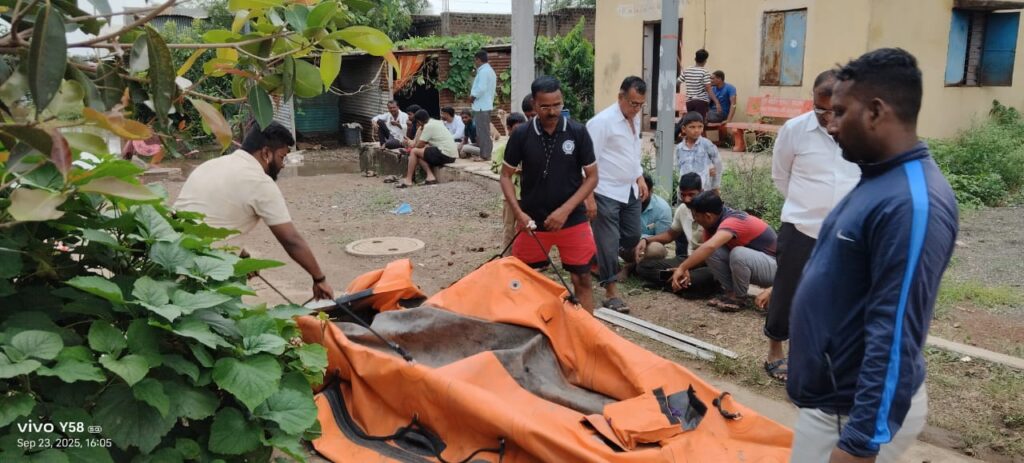
When heavy monsoon rains struck Solapur in September 2025, flooding swept through villages and low-lying areas, displacing thousands and endangering lives. The state machinery swung into action — the NDRF deployed multiple teams, and local administrations mobilized rescue and relief efforts.
Amid this crisis, the Aapda Mitras trained by the Indian Rescue Academy (IRA) emerged as vital front-line support. Under the district’s incident command protocols, they seamlessly integrated with disaster response operations to provide swift, localized relief. Maharashtra SDMA’s records show that Aapda Mitra and Aapda Sakhi volunteers were actively engaged in rescue and relocation efforts, particularly in flood-prone hamlets.
Roles & Impact
- First Response & Evacuation Support
Many IRA-trained Aapda Mitras were among the first on the ground, navigating submerged roads and flooded fields to reach trapped locals. They assisted in evacuating residents to safer ground and relief camps, often bridging the critical “last-mile” gap before larger rescue teams arrived. - Health & Safety Assistance
Equipped with basic emergency and first-aid skills taught during IRA training, these volunteers provided immediate care and stabilized victims until paramedics or medical teams could reach them. - Community Coordination & Local Intelligence
Their local presence allowed them to act as information nodes — guiding external rescue teams, identifying vulnerable households, and coordinating safe routes. This reduced duplication and improved the speed and reach of rescue efforts. - Relief & Resource Distribution
In coordination with the administration, they helped distribute essentials like food, water, and blankets—especially in areas where conventional infrastructure was cut off.
Illustrating the Scale
- In the Solapur floods, 4,002 people were rescued district-wide and 6,500 people stayed in relief camps.
- The NDRF reported rescuing 82 people from Solapur alone using their deployed resources.
- While large agencies handled broader evacuations, the IRA-trained Aapda Mitras’ localized actions made a tangible difference in remote and flood-cut villages, where timely intervention meant faster life-saving support.
The Solapur floods clearly demonstrated that trained local volunteers amplify state rescue capacity. The IRA’s investment in building a grassroots force through Aapda Mitra training paid dividends: volunteers who knew their areas, could act rapidly, and bridge the response gap until state resources arrived.